

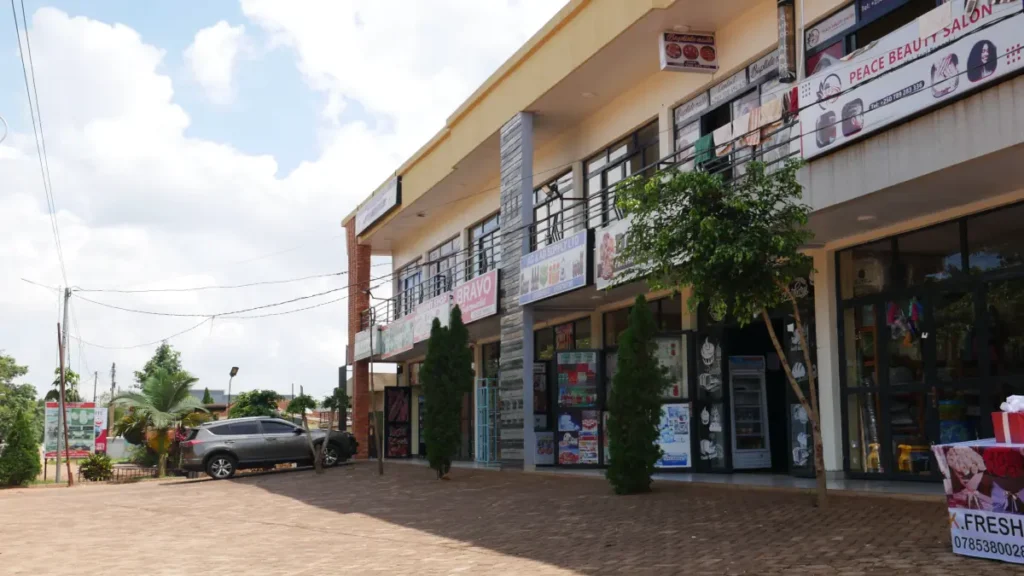
Kigali’s commercial landscape is defined by a “Do-for-Self” culture. Unlike Western cities dominated by corporate chains, Kigali is a city of entrepreneurs. This spirit is physically manifested in the Commercial Plaza—multi-story, multi-purpose buildings that serve as the economic heart of every residential sector.
The retail market is highly homogeneous. Because formal jobs are scarce, many people start identical businesses—such as salons or small supermarkets—leading to intense clustering where neighbors compete through relationships rather than unique branding.
Plazas: The Business Standard
In Kigali, unless you have a dedicated standalone location, doing business almost always requires a spot in a plaza or a commercial high-rise. Even in primarily residential areas, these structures are the first to rise at major intersections. They aren’t just buildings; they are vertical neighborhoods of trade.

A neighborhood plaza showing the multi-story “room-based” layout where independent merchants operate.

The early stages of a new plaza rising in a residential area, a sign of the rapid commercial “in-filling” happening across the city.
The Homogeneous Market
One of the most striking features for newcomers is the clustering of identical stores. It is common to see two or three neighborhood supermarkets directly next to each other. In this environment, shopping is a matter of personal relationship—you shop at the store owned by a friend or a neighbor rather than out of brand loyalty.

Businesses often sell identical products, creating a market where availability and personal connection are the main competitive advantages.

A close-up of the small-scale retail units that fill the ground floor of most plazas.
Anchor Tenants: Pharmacies and Irembo
Every plaza has “anchors” that residents rely on. The Pharmacy (Farumasi) is easily identified by the white cross. Often open 24/7, these are not just for prescriptions; they serve as the primary neighborhood source for skincare, hygiene products, and baby supplies. Alongside them, you will almost always find an Irembo agent.

Pharmacies and Irembo agents are essential anchors for commercial buildings, providing high-end health and digital government services.
ATMs and Security
Finding a reliable ATM is a priority for any newcomer. In Kigali, ATMs are usually located in dedicated cubicles at the corner of plazas or banks. These ATMs are almost always guarded by a private security firm 24/7, making them very safe to use at any hour.

ATMs are usually found in clusters near plaza entrances, consistently monitored by on-site security guards.
New to the City?
From mastering Umuganda to setting up your SIM card and MoMo, read our comprehensive guide for your first 24 hours in Kigali.